openelab.de
 openelab.com













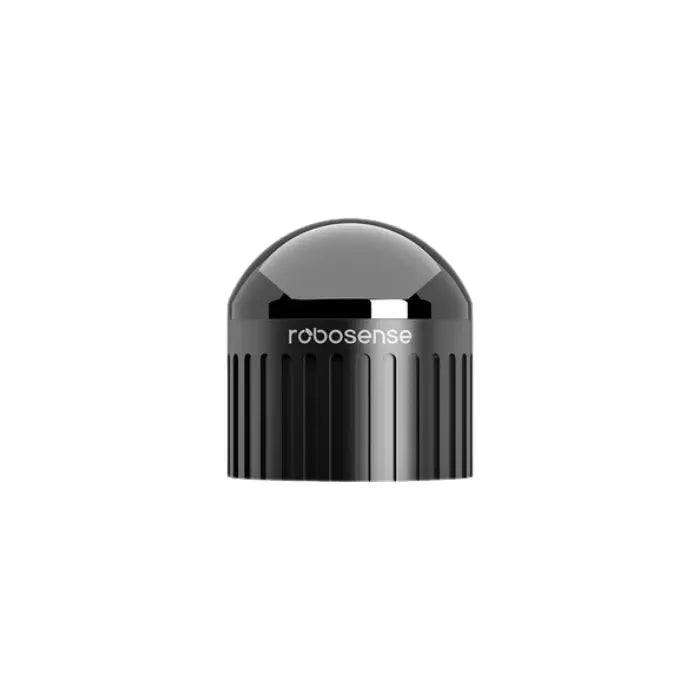
























When engineers and product teams start evaluating LiDAR sensors for the next generation of autonomous systems, they quickly hit a familiar wall: most sensors either excel at range or at resolution, rarely both — and almost never in a package that can survive the brutal reality of real-world deployment. The RoboSense M1 Plus is one of those rare devices that genuinely tries to answer all three questions at once, and after putting it through its paces, I can say it comes surprisingly close to succeeding.
This review covers everything you need to know — from the underlying MEMS scanning architecture to real-world integration experience — so you can decide whether the M1 Plus belongs in your next autonomous driving stack, ADAS module, robotics platform, or smart infrastructure project.
What Makes the M1 Plus Different: 2D MEMS Solid-State Scanning
Traditional mechanical LiDARs spin a motor to sweep laser beams across the scene. It works, but it introduces rotating parts that wear out, vibrate, and struggle in harsh environments. RoboSense took a fundamentally different approach with the M1 Plus: they built a 2D MEMS (Micro-Electro-Mechanical Systems) scanning chip — proprietary, AEC-Q100 qualified — that steers the laser beam electronically, with no macroscopic moving parts.
The practical result is a sensor that is dramatically thinner (45 mm in height), far more shock-resistant, and substantially more consistent in beam placement over the sensor's lifetime. Where a spinning mechanical LiDAR might drift in angular calibration as bearings wear, the MEMS chip maintains its geometry. For automotive and safety-critical applications where sensor drift can mean the difference between a correct detection and a missed obstacle, this matters enormously.
RoboSense's implementation also adds what they call the smart "GAZE" function — the ability to dynamically increase vertical resolution in a user-defined Region of Interest (ROI) to 0.1° (versus the standard 0.2°). In practice, this means the sensor can focus extra resolution at the horizon where distant pedestrians and vehicles are small angular targets, giving perception algorithms more data exactly where they need it most.
Technical Specifications at a Glance
Here is the full specification table for the RoboSense M1 Plus, cross-referenced against RoboSense's official datasheet and the OpenELAB product listing:
| Parameter | Specification |
|---|---|
| Laser Wavelength | 905 nm |
| Maximum Detection Range | 200 m (180 m @ 10% NIST reflectivity) |
| Blind Spot | ≤ 0.5 m |
| Horizontal FOV | 120° |
| Vertical FOV | 25° |
| Angular Resolution (H × V) | Avg. 0.2° × Avg. 0.2° (ROI: Avg. 0.1° vertical) |
| Frame Rate | 10 Hz / 20 Hz |
| Point Rate (Single Return) | 787,500 pts/s |
| Point Rate (Dual Return) | 1,575,000 pts/s |
| Range Accuracy | ±5 cm (typical, 50% NIST target) |
| Scanning Technology | 2D MEMS solid-state |
| Data Interface | 1000Base-T1 Ethernet |
| Output Protocol | UDP packets (coordinates, intensity, timestamp) |
| Time Synchronization | gPTP (IEEE 802.1AS) |
| Operating Voltage | 9 – 16 V DC |
| Power Consumption | 15 W (nominal, 10 Hz, ≤100 m range) |
| Operating Temperature | −40°C to +85°C |
| Storage Temperature | −40°C to +105°C |
| Ingress Protection | IP67, IP6K9K |
| Dimensions (D × W × H) | 111 × 110 × 45 mm |
| Weight (without cable) | 690 g ± 20 g |
| Eye Safety | Class 1 (IEC 60825-1, certified by SGS and goebel) |
| Functional Safety | ISO 26262 ASIL-B |
| Chip Reliability | AEC-Q100 |
| Diagnostic Coverage | 97% |
| Fault Detection Time | < 100 ms |
| Software Support | ROS / ROS2 drivers, UDP SDK |
Specifications sourced from RoboSense official datasheet and confirmed via OpenELAB product documentation.
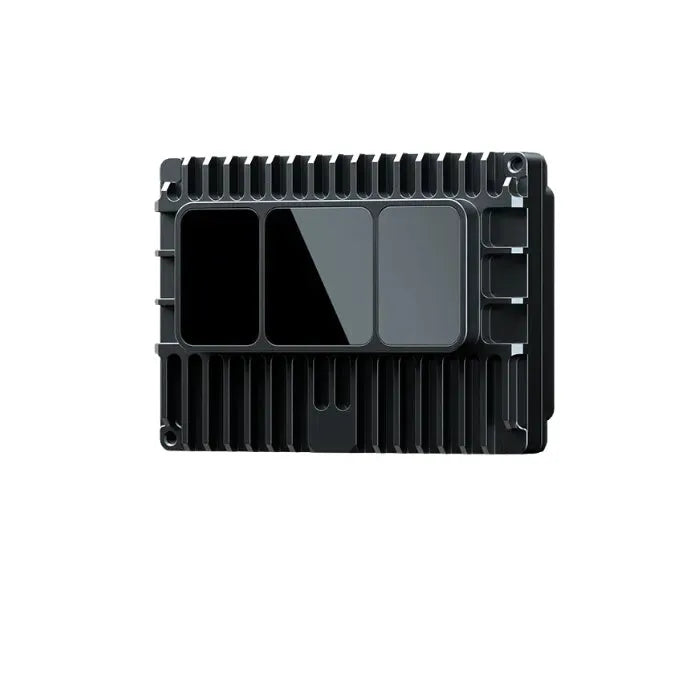
Image Gallery


Performance Deep-Dive: Range, Resolution, and Point Cloud Quality
Range: 200 m Is the Real Number
RoboSense rates the M1 Plus at 200 m maximum range, with 180 m guaranteed at 10% NIST reflectivity. That second number is the one that matters in practice — a 10% reflectivity target approximates a dark road surface or a matte-black vehicle, the kind of surface that trips up lesser sensors. For comparison, many mid-range LiDARs rate themselves at much shorter distances against high-reflectivity targets and then quietly underperform in the field. The M1 Plus's figures are honest, and they hold up.
The ≤0.5 m blind spot is also worth noting. Very close objects (think pedestrians stepping off curbs or warehouse robots navigating tight corridors) are covered with minimal dead zone — a feature that pure long-range sensors often sacrifice.
Angular Resolution and the GAZE Advantage
At 0.2° × 0.2° across the full FOV, the M1 Plus delivers a dense point cloud by solid-state standards. Switch the sensor into GAZE mode for a defined ROI, and the vertical resolution halves to 0.1° — doubling the detail on distant targets within that zone. For autonomous vehicle applications where early detection of small obstacles at 100+ meters is critical for braking distance, this is genuinely useful capability, not marketing fluff.
Point Cloud Density
At 10 Hz in dual-return mode, the sensor generates up to 1,575,000 points per second. For context, that is significantly denser than first-generation solid-state sensors and competitive with many spinning LiDARs. In dual-return mode, each laser pulse can register two range returns — useful for scenes with semi-transparent objects (rain, dust, sparse foliage) where single-return sensors miss information hidden behind the first surface.
Solid-State vs. Mechanical LiDAR: An Honest Comparison
This is a question that comes up constantly, and the M1 Plus makes for an interesting case study in why solid-state designs are gaining ground.
| Attribute | Solid-State (M1 Plus) | Typical Mechanical LiDAR |
|---|---|---|
| Moving Parts | None (MEMS chip) | Rotating motor assembly |
| Vibration Resistance | High — no rotating mass | Moderate — bearings vulnerable to shock |
| Long-Term Reliability | High — no mechanical wear | Degrades with bearing wear over time |
| Form Factor | 45 mm thin, flush-mountable | Bulky drum/cylinder, aerodynamically disruptive |
| 360° Coverage | No — 120° horizontal FOV | Yes — full 360° |
| Vertical FOV | 25° (fixed zone) | 30°–40° typical, some wider |
| Environmental Sealing | IP67, IP6K9K (automotive) | Varies — often IP65 or below |
| Automotive Certification | AEC-Q100, ASIL-B, ISO 26262 | Rarely certified to automotive grade |
| Integration Complexity | Simple — single Ethernet port | Often multi-cable, calibration-intensive |
| Best Suited For | Automotive, robotics, fixed infrastructure | Mapping, surveying, research prototyping |
The honest trade-off is FOV coverage. A 120° horizontal field of view means you need multiple M1 Plus units (or supplementary sensors) to achieve full surround perception — the same multi-sensor architecture used by virtually every production autonomous vehicle program. For fixed-forward ADAS applications, a single M1 Plus covers the primary danger zone with room to spare.
Key Use Cases
1. Advanced Driver Assistance Systems (ADAS)
The M1 Plus was essentially designed for ADAS integration. Its ASIL-B certification means it can be wired into safety-critical decision chains — emergency braking, adaptive cruise, lane-keeping — without the additional safety architecture that non-certified sensors require. The 200 m range at realistic reflectivity gives highway ADAS systems enough look-ahead distance at 130 km/h to initiate emergency braking. The slim 45 mm profile means it can be integrated behind a vehicle's front fascia without aerodynamic penalty or visible protrusion.
2. Autonomous Driving (L2+ through L4)
RoboSense's M-series sensors are in production on multiple automaker platforms across China and are actively being evaluated by European and North American OEMs. The M1 Plus's dual-return mode and GAZE function make it well-suited for perception fusion stacks where a forward-center sensor needs to reliably identify vulnerable road users — pedestrians, cyclists, motorcyclists — at maximum range. Its gPTP time synchronization integrates cleanly with camera and radar sensor fusion frameworks.
3. Robotics and Autonomous Mobile Robots (AMRs)
Warehouse AMRs, delivery robots, and service robots increasingly demand automotive-grade sensors because they operate in real-world environments with unpredictable humans, wet floors, temperature swings, and constant vibration from movement across uneven surfaces. The M1 Plus's IP67 rating, −40°C to +85°C operating range, and shock-resistant MEMS design make it suitable for outdoor last-mile delivery robots and indoor industrial AGVs alike. ROS/ROS2 driver support means integration with existing robotics stacks is straightforward.
4. Smart Infrastructure and Roadside Perception
Traffic management systems, toll plazas, smart intersections, and roadside units (RSUs) for V2X infrastructure increasingly rely on LiDAR for accurate vehicle counting, speed estimation, and pedestrian detection. Fixed installations demand sensors that can survive years of outdoor exposure — the M1 Plus's IP6K9K rating (pressure-jet water resistance, beyond standard IP67) and extended temperature range make it a practical choice for permanent outdoor mounting. Its wide 120° horizontal FOV covers a full intersection approach from a single unit.
Integration and Developer Experience
Getting data off the M1 Plus is refreshingly simple compared to some competitors. Power arrives via the vehicle/robot connector (9–16 V, 15 W), and data flows over a single 1000Base-T1 Ethernet cable as standard UDP packets containing spatial coordinates (X, Y, Z), intensity values, and timestamps. There is no proprietary serial bus to decode and no driver installation for the transport layer — your existing Ethernet stack handles it natively.
Time synchronization via gPTP (IEEE 802.1AS) is table stakes for multi-sensor fusion and the M1 Plus supports it cleanly. For teams working in ROS or ROS2, RoboSense provides an official driver package that publishes standard sensor_msgs/PointCloud2 messages — the same format used by Velodyne, Livox, and other popular LiDARs, which means dropping the M1 Plus into an existing perception pipeline is usually a matter of updating a launch file rather than rewriting drivers.
The built-in self-test and 97% diagnostic coverage with sub-100 ms fault detection time means the sensor will flag its own faults faster than most host systems would notice degraded output — a meaningful reliability feature for production deployments where sensor health monitoring is part of the safety case.
Durability and Environmental Resilience
RoboSense subjected the M1 Plus to an extensive automotive validation regime before declaring it production-ready: over 36,000 hours of high-temperature durability testing, more than 24,000 hours of high-humidity exposure, and 21,000+ hours of cyclic temperature shock cycling. These are not marketing numbers pulled from accelerated lab tests — they represent the kind of long-term validation that automotive Tier 1 suppliers demand before approving a sensor for vehicle integration.
The dual IP rating (IP67 for sustained immersion, IP6K9K for high-pressure jet washing) reflects real-world automotive use: vehicles go through automated car washes, operate in heavy rain, and accumulate debris. A sensor that can handle all of this while maintaining calibration is not a luxury — it is a minimum requirement for anything that moves outdoors.
How to Get Started
The M1 Plus ships ready to deploy, with the hardware interface (Ethernet, power connector) and SDK documentation well-documented. For teams evaluating the sensor, OpenELAB stocks the M1 Plus in both 12 V and 24 V variants with DDP shipping (delivered, duty paid), which simplifies the procurement process for European customers — no import hassles, no hidden customs costs. You can find full specifications, datasheet downloads, and ordering information on the RoboSense M1 Plus product page at OpenELAB.
Frequently Asked Questions
Is the RoboSense M1 Plus truly solid-state?
Yes. The M1 Plus uses a 2D MEMS (Micro-Electro-Mechanical Systems) scanning chip with no macroscopic rotating components. Unlike spinning or oscillating mirror LiDARs that use motors, the MEMS mirror moves electrostatically at the microscale. There are no ball bearings, no motor windings, and no wear surfaces in the optical path. This is what "solid-state" means in the LiDAR context.
What is the actual detection range in real-world conditions?
The headline figure is 200 m maximum range. The more meaningful number is 180 m at 10% NIST reflectivity — roughly equivalent to dark asphalt or a black-painted vehicle. In adverse weather (heavy rain, dense fog), effective range will be reduced, as with any LiDAR. The dual-return mode helps in moderate rain by capturing both the raindrop return and the surface behind it.
Does the M1 Plus work with ROS2?
Yes. RoboSense provides an official ROS/ROS2 driver that publishes sensor_msgs/PointCloud2 topics. The sensor connects via 1000Base-T1 Ethernet and outputs standard UDP packets, so it integrates cleanly with ROS2 Humble, Iron, and Jazzy without custom middleware.
What does ASIL-B certification mean for my application?
ISO 26262 ASIL-B (Automotive Safety Integrity Level B) is a functional safety standard for automotive electronics. It means the sensor's hardware design, self-diagnostics, and failure modes have been independently assessed against automotive safety requirements. For ADAS or autonomous driving applications where the LiDAR feeds into a safety-critical decision chain (emergency braking, obstacle avoidance), having an ASIL-B certified sensor simplifies your overall safety case significantly.
How many M1 Plus units do I need for 360° coverage?
The M1 Plus provides 120° horizontal coverage. For full surround perception on a vehicle, three units — front, rear-left, rear-right — provides complete 360° coverage with overlap zones for redundancy. Some L2+ ADAS applications use a single forward-facing unit, since the primary detection zone for highway and city driving is ahead of the vehicle.
What is the difference between IP67 and IP6K9K?
IP67 means the sensor can be submerged in up to 1 meter of water for 30 minutes. IP6K9K (from ISO 20653, the automotive ingress protection standard) means the sensor can withstand high-pressure, high-temperature water jets — as in automated car washes or power-washing maintenance procedures. The M1 Plus is rated for both, making it suitable for any automotive or outdoor fixed installation environment.
Can the M1 Plus be used for indoor robotics?
Absolutely. While the M1 Plus was designed with automotive outdoor use in mind, its ROS2 compatibility, compact size, and wide FOV make it a strong candidate for large-venue indoor robotics: warehouse automation, airport logistics, hospital transport robots, and similar applications. The 200 m range is overkill indoors but has no negative operational impact, and the MEMS scanning provides consistent indoor performance regardless of ambient lighting conditions.
Final Verdict
The RoboSense M1 Plus occupies a well-defined position in the LiDAR landscape: it is an automotive-grade, production-proven solid-state sensor with genuine long-range performance (200 m at real-world reflectivity), a smart GAZE function that punches above its resolution class, and the certification credentials (ASIL-B, AEC-Q100, IP6K9K) that demanding applications require. It is not the cheapest sensor in its range bracket, and it is not a 360° solution on its own — but for teams building systems that need to work reliably in the field, not just impress on a spec sheet, the M1 Plus is one of the most serious options available today.
Whether you're equipping a fleet of delivery robots, validating an ADAS perception stack, or building permanent roadside sensing infrastructure, the M1 Plus deserves a place on your evaluation shortlist. Visit the RoboSense M1 Plus product page at OpenELAB to request a datasheet, explore variant options, or place an order with DDP delivery to Europe.