openelab.de
 openelab.com







































PMR446 walkie talkies are popular in Europe because they offer simple short-range communication without the setup complexity of licensed business radios or amateur radio equipment. More precisely, PMR446 is licence-exempt when you use compliant PMR446 equipment according to the rules of the country where you operate it. These radios are useful for families, hiking groups, campsites, event teams, warehouses, schools, small venues, and travel coordination where mobile phone coverage or group calling is not ideal.
The short answer: choose a PMR446 radio that is sold as a PMR446-compliant handheld for your market, not a high-power programmable radio that merely covers 446 MHz. For casual users, a compact 2-pack is enough. For families and small teams, a 3-pack or 4-pack is easier to manage. For outdoor or harsher environments, choose a more rugged model with stronger battery capacity and weather-resistant construction.
This OpenELAB buying guide compares PMR446 options such as the Radioddity PR-T1 PMR446 1-pair radio set, Radioddity PR-T3 PMR446 2-pack, Baofeng BF-33C PMR446 family radio 3-pack, Baofeng BF-88ST PRO PMR446 2-pack, Baofeng GT-22 PMR446 2-pack, and Radioddity HD-1 PMR446 IP67 2-pack.
Regulatory boundary: this article is a buying guide, not legal advice. PMR446 rules can depend on the country and the exact equipment. In general European PMR446 buying, look for compliant handheld PMR446 radios using the 446.0 to 446.2 MHz range, 0.5W / 500mW ERP operation, simplex peer-to-peer use, and fixed or integral antennas. Do not assume that any radio capable of transmitting near 446 MHz is legal to use as PMR446.
Browse PMR446 walkie talkies at OpenELAB

Quick Answer: Which PMR446 Walkie Talkie Should You Buy?
| Use case | Recommended direction | OpenELAB examples | Why it fits |
|---|---|---|---|
| Couples, travel, simple everyday use | Compact 2-pack | Radioddity PR-T1 1-pair set, Radioddity PR-T3 2-pack | Easy to carry, simple for two-person coordination, and less bulky than heavy-duty radios. |
| Families, campsites, day trips, small groups | 3-pack or 4-pack | Baofeng BF-33C 3-pack, Radioddity PR-T1 4-radio set | More radios keep adults, kids, vehicles, or activity groups connected without sharing units. |
| Outdoor teams and harsher environments | Rugged or weather-resistant PMR446 set | Radioddity HD-1 IP67 2-pack, Radioddity HD-1 IP67 4-pack | Better fit when dust, rain, glove use, drops, and longer sessions matter. |
| Small teams that want simple visual identification | Color-coded or multi-radio kit | Baofeng GT-18 color 3-pack, Baofeng GT-18 camo 3-pack | Different colors or sets can make it easier to assign radios by user, vehicle, or group. |
What Is PMR446?
PMR446 is a short-range personal mobile radio category used across much of Europe for simple two-way communication. It is designed for low-power handheld radios that communicate directly with each other, usually without repeaters, base stations, mobile phone networks, or paid radio service plans.
For a buyer, the most important point is compliance. PMR446 is not just "any radio set to 446 MHz." The equipment must be designed and operated as compliant PMR446 equipment for the relevant country. In typical European buying terms, that means handheld use, low-power output, PMR446 channel operation, and fixed or integral antennas.
PMR446 Rules Buyers Should Understand
Regulators describe PMR446 as low-power, short-range, peer-to-peer radio. The common European PMR446 frequency range is 446.0 to 446.2 MHz, and the usual maximum effective radiated power is 0.5W / 500mW ERP. Compliant PMR446 radios are normally handheld devices with fixed or integral antennas.
These limits are not a weakness in the product category. They are the reason PMR446 can be licence-exempt when users operate compliant equipment. The lower power and fixed antenna approach helps keep many users sharing the same small radio band without turning it into a high-power interference problem.
Country rules can still vary. If you are buying for a workplace, cross-border travel, organized events, or commercial use, confirm local rules and product compliance. Analogue PMR446 is usually the safer general category for simple Europe-wide consumer use. Digital PMR446 rules and features can be more country-specific, so do not assume digital operation is accepted everywhere without checking.
| PMR446 compliance point | What it means for buyers |
|---|---|
| 446.0 to 446.2 MHz | This is the common PMR446 frequency range, but frequency coverage alone is not enough. The radio must be compliant PMR446 equipment. |
| 0.5W / 500mW ERP | Do not choose by high transmit power. PMR446 is designed as low-power short-range radio. |
| Handheld use | PMR446 is for portable handheld communication, not base stations or fixed infrastructure. |
| Fixed or integral antenna | For licence-exempt PMR446 buying, avoid radios built around removable external antennas. |
| Simplex peer-to-peer operation | PMR446 is mainly radio-to-radio communication, not repeater-based wide-area coverage. |
| Not a protected service | Other users may share the same channels. PMR446 is useful for local coordination, not guaranteed private or interference-free communication. |
Do Not Use a High-Power Programmable Radio as PMR446
This is the biggest buying mistake. Some VHF/UHF handheld radios can be programmed near PMR446 frequencies, but that does not automatically make them legal PMR446 radios. If the radio has higher transmit power, a removable antenna, wide frequency access, or non-PMR446 configuration, it may not qualify for licence-exempt PMR446 use.
For most buyers, the simpler and safer route is to buy a radio sold specifically as PMR446. That keeps the channel plan, power level, antenna setup, and intended use aligned with what casual users normally need.
Best PMR446 Radios by Buyer Type
Families and kids: BF-33C, PR-T1, and PR-T3
The Baofeng BF-33C PMR446 3-pack is positioned as a ready-to-use family radio set for outdoor coordination. A 3-pack makes sense when one radio pair is not enough: one adult can carry one radio, another adult can carry a second, and a child, group leader, or second vehicle can carry the third.

The Radioddity PR-T1 PMR446 1-pair set and Radioddity PR-T3 PMR446 2-pack are better fits when you only need two radios. This is the simplest option for travel, short hikes, campsite coordination, festivals, parking help, and small venue tasks.
Hiking and outdoor small groups: GT-18 and GT-22
The Baofeng GT-18 PMR446 color 3-pack, Baofeng GT-18 camo 3-pack, and Baofeng GT-22 PMR446 2-pack are useful for lightweight outdoor coordination where each person or subgroup needs a simple handheld radio.
Work teams and four-radio kits: BF-88ST PRO and GT-22
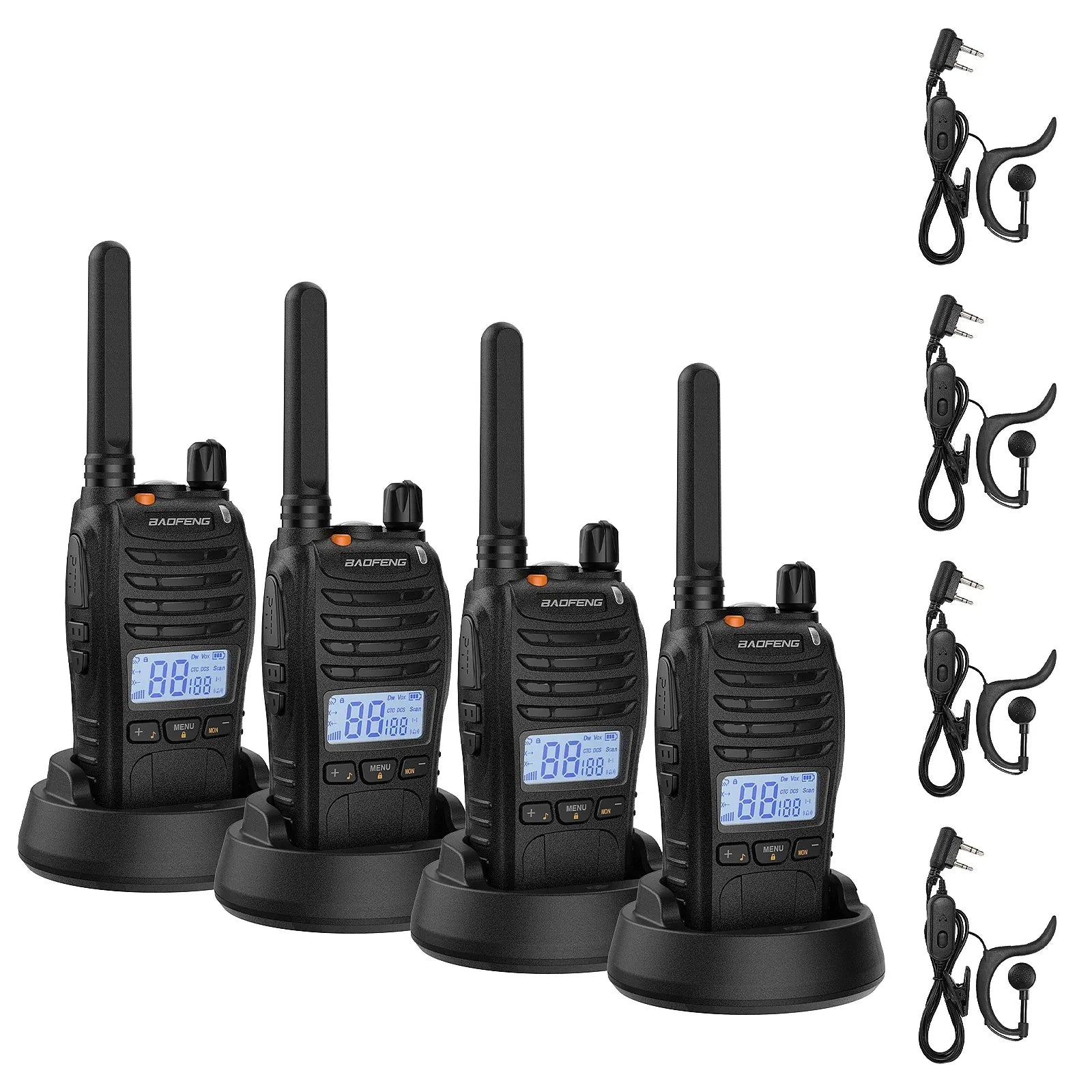
The Radioddity PR-T1 PMR446 4-radio set, Baofeng BF-88ST PRO PMR446 4-pack, and Baofeng GT-22 PMR446 4-pack are more useful when several people need their own radios. For volunteers, shop floors, event stewards, small warehouses, school trips, or activity groups, a 4-pack avoids constant radio sharing.
Harsh environments: Radioddity HD-1 IP67
Choose the Radioddity HD-1 PMR446 IP67 2-pack or Radioddity HD-1 PMR446 IP67 4-pack if the radio will be used around rain, dust, outdoor work, camping, hiking, or rougher team environments. Ruggedness matters more than slim design when the radio may be dropped, handled with gloves, or used for longer outdoor sessions.
Italian voice prompts and travel: Radioddity Echo-IT
The Radioddity Echo-IT PMR446 2-pack is listed with Italian voice prompts. That makes it a niche but practical option when Italian voice guidance is helpful for the user group.
PMR446 Range: What to Expect
PMR446 range is practical, not magical. The 0.5W ERP limit and fixed antenna design are meant for short-range communication. Range can be good across open fields, campsites, beaches, construction yards, and line-of-sight outdoor spaces. It drops quickly in dense buildings, underground areas, forests, city streets, vehicles, hills, and metal-heavy environments.
Do not buy PMR446 expecting the same coverage as a cellular network, business repeater system, marine radio, or licensed high-power setup. If a project needs guaranteed wide-area communication, formal site coverage, emergency services reliability, or building-wide professional coverage, PMR446 may not be enough.
Privacy Codes Are Not Encryption
Many walkie talkies use CTCSS or DCS tone/code settings, often described casually as privacy codes. They are useful because they reduce how often you hear other users on the same channel. They do not make the conversation encrypted, private, or secure. Other users on the same PMR446 channel can still exist nearby, and a radio without the same tone filter may still hear traffic.
For family trips, events, and small teams, these codes are still useful because they make the radio quieter and easier to share. Just do not use PMR446 as if it were a protected private communication service.
Key Features to Compare
| Feature | Why it matters | Buying guidance |
|---|---|---|
| Pack size | Controls how many people can communicate at once. | Choose 2-pack for pairs, 3-pack for families, 4-pack for teams. |
| Battery capacity and charging | Affects all-day convenience and charging logistics. | USB-C is convenient for modern travel kits; larger batteries help long sessions. |
| Ruggedness and ingress protection | Matters outdoors, around dust, rain, and rough handling. | Choose rugged models such as IP-rated radios for harsh environments. |
| Size and weight | Small radios are easier for travel and kids; larger radios may feel more durable. | Match the radio body to who will carry it and for how long. |
| Voice prompts and controls | Helps users understand settings without reading the screen. | Language-specific prompts can matter for families, travel, or mixed-experience groups. |
| Compliance positioning | PMR446 depends on using compliant equipment, not only 446 MHz frequency coverage. | Choose products sold as PMR446 radios for the relevant market. |
Common Buying Mistakes
- Buying a high-power radio because it looks stronger. For licence-exempt PMR446 use, compliance matters more than raw wattage.
- Assuming 446 MHz coverage equals PMR446 compliance. A radio must be built and configured for PMR446 requirements.
- Ignoring antenna rules. PMR446 buyers should avoid radios marketed around removable or external antennas for licence-exempt PMR446 use.
- Overestimating range. Buildings, hills, vehicles, forests, and city streets can reduce short-range UHF performance.
- Buying too few radios. If four people need to coordinate, a two-radio set creates sharing problems.
- Choosing only by battery size. Controls, ruggedness, charging type, pack size, and user age also matter.
- Depending on PMR446 for critical emergency communication. PMR446 is useful for local coordination, but it is not a guaranteed emergency network.
- Thinking CTCSS or DCS makes conversations private. Tone codes reduce unwanted audio but do not encrypt or secure PMR446 communication.
PMR446 vs Licensed Radios
PMR446 is best when you want simple, short-range communication using compliant licence-exempt handheld radios. Licensed business radios are different: they can support higher power, assigned channels, repeaters, better site planning, and more predictable coverage, but they require licensing and planning.
For casual family use, travel groups, hiking, campsite coordination, and small informal teams, PMR446 is often the simpler choice. For a business that needs guaranteed coverage, crowded radio environments, multiple sites, or formal safety procedures, a licensed system may be more appropriate.
FAQ
Do I need a licence to use PMR446 in Europe?
PMR446 is generally licence-exempt when the radio is compliant PMR446 equipment and is operated according to the relevant national rules. Because implementation can vary by country, check the rules for the country where you will use the radios.
Can I use a Baofeng or programmable radio on PMR446?
Only if the radio is sold and configured as compliant PMR446 equipment for your market. A high-power programmable radio that can tune near 446 MHz is not automatically legal for licence-exempt PMR446 use.
Why are PMR446 radios limited to 0.5W?
The low-power limit helps many users share the same short-range radio band without needing individual licences. It also helps reduce interference and keeps PMR446 focused on local communication.
How far can PMR446 walkie talkies communicate?
Range depends on terrain, buildings, trees, vehicles, radio placement, battery condition, and interference. Expect better results outdoors with line of sight and shorter range indoors or in dense urban areas.
Are PMR446 radios good for hiking?
They can be useful for hiking groups that stay within short-range communication distance. They are not a substitute for emergency beacons, mobile phone coverage, local rescue procedures, or proper trip planning.
Should I buy a 2-pack, 3-pack, or 4-pack?
Buy based on the number of people who need their own radio. A 2-pack is enough for two users. A 3-pack is useful for families or small outdoor groups. A 4-pack is better for teams, activities, and events.
Is digital PMR446 the same across Europe?
Do not assume that. Analogue PMR446 is the simpler broad category for casual buyers. Digital PMR446 features and acceptance may vary by country, so check local rules before relying on digital modes.
Final Recommendation
For most European buyers, the best PMR446 walkie talkie is a compliant, ready-to-use handheld radio set that matches the group size and environment. Choose a compact 2-pack for pairs, a 3-pack or 4-pack for families and teams, and a rugged IP-rated model for harsher outdoor use. Do not choose by transmit power alone, and do not assume any programmable 446 MHz radio is acceptable for licence-exempt PMR446 use.
Start by comparing compact 2-radio PMR446 sets, family-focused 3-radio PMR446 kits, and rugged PMR446 radios for outdoor teams at OpenELAB.