openelab.de
 openelab.com







































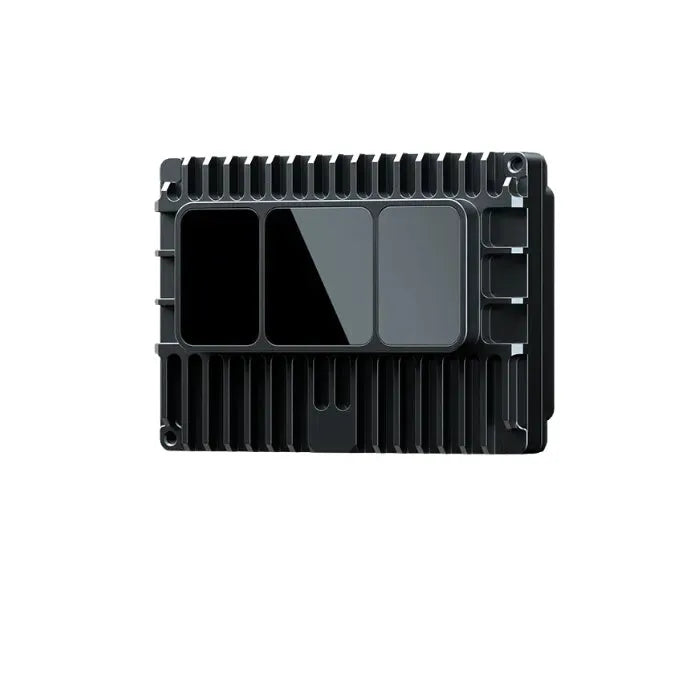
The Seeed Studio reComputer Robotics J4012 with GMSL Extension is an intelligent edge AI computer designed specifically for next-generation robotics applications. Built around the powerful NVIDIA Jetson Orin NX 16GB module, this compact yet powerful computing platform delivers up to 157 TOPS of AI computing power, making it ideal for demanding robotics, autonomous systems, and edge AI applications. Whether you're developing humanoid robots, autonomous mobile robots (AMRs), automated guided vehicles (AGVs), or industrial vision systems, the reComputer Robotics J4012 provides the computational horsepower and connectivity options needed to bring your robotic projects to life.
For those exploring other options in the Seeed Studio ecosystem, you might also consider the reComputer Industrial J4012 for industrial-focused applications or the reComputer Robotics J5012 for more demanding AI workloads. The reComputer J2021 offers another alternative for different deployment scenarios.
This article provides a comprehensive overview of the Seeed Studio reComputer Robotics J4012, exploring its specifications, features, applications, and how it compares to other solutions in the market. We'll dive deep into the technical details that make this edge AI computer stand out, including its integrated GMSL (Gigabit Multimedia Serial Link) camera support, rich I/O options, and industrial-grade design built for demanding environments. Additionally, we'll examine real-world use cases and provide practical guidance for developers looking to implement this platform in their robotics projects.
What is the Seeed Studio reComputer Robotics J4012?
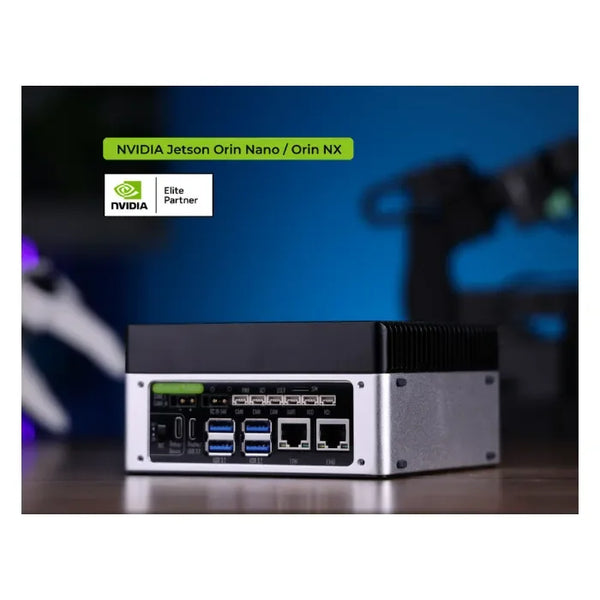
The Seeed Studio reComputer Robotics J4012 is an industrial-grade edge AI computing platform specifically engineered for robotics applications. It combines the powerful NVIDIA Jetson Orin NX 16GB module with a custom-designed carrier board that includes an integrated GMSL extension board for connecting multiple high-resolution cameras. Unlike general-purpose edge computing devices, this product is purpose-built for robotics, featuring extensive connectivity options including multiple CAN bus ports, industrial I/O interfaces, and support for various sensors and actuators commonly used in robotic systems.
The "J4012" designation indicates this is the robotics-focused variant of Seeed's reComputer series, with the "2" specifically denoting the inclusion of the GMSL Extension Board. This makes it distinct from other reComputer models that might focus on different use cases or form factors. The integration of GMSL technology is particularly significant for robotics applications, as it enables the connection of multiple automotive-grade cameras over long distances (up to 15 meters) while simultaneously providing power through coaxial cables, reducing the complexity of cable management in robotic systems.
One of the key differentiating factors of the reComputer Robotics J4012 is its comprehensive software support. The device comes pre-installed with JetPack 6.2 and Linux Board Support Package (BSP), meaning developers can begin working on their applications immediately without spending time on initial setup and configuration. This is particularly valuable for commercial deployments where time-to-market is critical.
Technical Specifications and Architecture
The reComputer Robotics J4012 is built around the NVIDIA Jetson Orin NX 16GB module, which represents a significant leap in edge AI computing performance. Let's examine the detailed specifications that make this platform so capable for robotics applications.
Processing Power and AI Capabilities
The heart of the reComputer Robotics J4012 is the NVIDIA Jetson Orin NX 16GB module, which delivers exceptional AI performance suitable for the most demanding robotics applications. The AI computing capability of up to 157 TOPS (Tera Operations Per Second) in MAXN mode represents approximately a 1.7x performance boost compared to previous generations, enabling real-time processing of complex neural networks for object detection, semantic segmentation, path planning, and other AI-driven robotics tasks.
The GPU architecture is based on the NVIDIA Ampere design, featuring 1024 cores and 32 Tensor Cores operating at a maximum frequency of 1173 MHz. This processing power is essential for handling multiple camera streams simultaneously, running deep learning inference, and performing real-time sensor fusion - all critical capabilities for modern robotics applications.
The CPU is an 8-core NVIDIA Arm Cortex A78AE v8.2 64-bit processor with 2MB L2 cache and 4MB L3 cache, operating at up to 2.0 GHz. The A78AE (Automotive Enhanced) variant is specifically designed for automotive and industrial applications, offering improved reliability and real-time processing capabilities compared to standard consumer-oriented processors. This ensures the reComputer Robotics J4012 can handle the deterministic processing requirements of robotics control systems.
In addition to the main CPU and GPU, the Jetson Orin NX includes specialized accelerators for deep learning and vision processing. The 2 NVDLA (NVIDIA Deep Learning Accelerator) v2.0 cores operate at up to 1.23 GHz, providing dedicated hardware acceleration for neural network inference. The PVA (Programmable Vision Accelerator) v2.0 offers additional vision processing capabilities, enabling efficient handling of computer vision workloads alongside the main AI processing pipeline.
| Specification | Details |
|---|---|
| AI Performance | 157 TOPS (MAXN mode) |
| GPU | 1024-core NVIDIA Ampere with 32 Tensor Cores |
| GPU Max Frequency | 1173 MHz |
| CPU | 8-core Arm Cortex A78AE v8.2 64-bit |
| CPU Max Frequency | 2.0 GHz |
| Memory | 16GB 128-bit LPDDR5 @ 102.4GB/s |
| DL Accelerator | 2 x NVDLA v2.0 |
| Vision Accelerator | 1 x PVA v2.0 |
| Power Modes | 10W / 15W / 25W / 40W |
Memory and Storage
The reComputer Robotics J4012 features 16GB of 128-bit wide LPDDR5 DRAM operating at 102.4 GB/s bandwidth. This high-bandwidth memory is essential for handling the data-intensive requirements of multiple camera streams, real-time AI inference, and complex robotics control algorithms. The large memory capacity also allows for running multiple concurrent AI models and maintaining larger neural network architectures that would be memory-constrained on platforms with less RAM.
For storage, the carrier board provides a dedicated M.2 Key M slot supporting PCIe-based NVMe SSDs. The included 128GB NVMe SSD provides fast boot times and sufficient storage for the operating system, AI models, and application data. This storage configuration is particularly important for robotics applications that need to operate reliably without network connectivity, as all necessary software and models can be stored locally.
Video Encoding and Decoding Capabilities
Modern robotics applications frequently involve processing multiple video streams simultaneously, making robust video encoding and decoding capabilities essential. The Jetson Orin NX in the reComputer Robotics J4012 provides comprehensive video processing capabilities that exceed the requirements of most robotics applications.
For video encoding, the platform supports hardware-accelerated H.265 (HEVC) encoding at resolutions up to 4K at 60 frames per second. It can encode up to three 4K30 streams, six 1080p60 streams, or twelve 1080p30 streams simultaneously. This flexibility allows robotics developers to configure the optimal encoding settings based on their specific requirements for video quality, bandwidth, and storage.
Video decoding capabilities are equally impressive, with support for 8K30 H.265 decoding, dual 4K60 streams, four 4K30 streams, nine 1080p60 streams, or eighteen 1080p30 streams. These capabilities are particularly valuable for robotics applications that need to process video from multiple sources, including recorded footage for training, streaming video for remote monitoring, and real-time camera feeds for autonomous navigation.
Connectivity and I/O Options
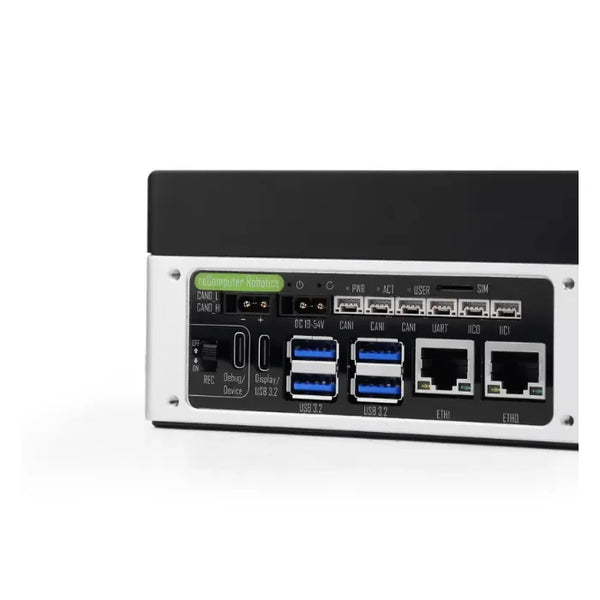
One of the most significant advantages of the Seeed Studio reComputer Robotics J4012 for robotics applications is its comprehensive connectivity options. The carrier board has been specifically designed to meet the diverse I/O requirements of robotic systems, providing multiple interfaces for sensors, actuators, communication modules, and external devices.

Network Connectivity
The reComputer Robotics J4012 provides versatile networking capabilities through both wired and wireless options. Two RJ-45 Gigabit Ethernet ports offer high-speed wired connectivity for integration with industrial networks, enabling communication with supervisory systems, cloud platforms, and other networked devices. The dual Ethernet ports also support link aggregation for increased bandwidth or redundancy - a valuable feature for mission-critical robotics applications.
For wireless connectivity, the platform includes an M.2 Key E slot that can accommodate Wi-Fi and Bluetooth modules. This allows deployment in environments where wired connectivity is impractical or enables the robot to operate autonomously while periodically syncing data with central systems. Additionally, an M.2 Key B slot supports 5G cellular modules for applications requiring ultra-low latency mobile connectivity or operation in areas without Wi-Fi infrastructure.
USB Connectivity
USB connectivity on the reComputer Robotics J4012 is exceptionally comprehensive, featuring six USB 3.2 Type-A ports operating at 5Gbps. These ports can connect a wide variety of peripherals including USB cameras, storage devices, human interface devices, and industrial sensors. The high bandwidth of USB 3.2 ensures that multiple high-resolution cameras can be connected without bandwidth constraints.
A USB 3.0 Type-C port provides additional flexibility with support for DisplayPort 1.4 output, enabling connection to external monitors for debugging or human-machine interface applications. A second USB 2.0 Type-C port operates in device mode, facilitating firmware updates, debugging, and connection to host computers for development purposes.
Industrial Communication Interfaces
For robotics applications, industrial communication interfaces are often more critical than general-purpose connectivity. The reComputer Robotics J4012 excels in this area with multiple CAN bus ports, RS-485 support, and various other industrial interfaces.
The CAN (Controller Area Network) bus is fundamental to automotive and industrial robotics, enabling reliable communication between the main computing unit and motor controllers, sensors, and other electronic control units. The reComputer Robotics J4012 provides extensive CAN connectivity with two CAN0 ports via XT30 connectors (2+2 configuration) and three CAN1 ports via 4-pin GH headers. This comprehensive CAN support enables integration with a wide variety of industrial equipment and robotic components.
The CAN bus protocol is particularly well-suited for robotics applications due to its inherent reliability, error detection capabilities, and support for real-time communication. In autonomous mobile robots and automated guided vehicles, CAN bus enables millisecond-level coordination between joint controllers, ensuring precise motion control and synchronization across the entire robotic system.
Additional industrial interfaces include dual I2C headers for connecting temperature sensors, humidity sensors, IMUs (Inertial Measurement Units), and fuel gauge ICs. A UART header facilitates connection to LiDAR sensors commonly used in robotics for mapping and obstacle detection. These interfaces enable the creation of comprehensive sensor suites that provide the environmental awareness necessary for autonomous operation.
GMSL Camera Extension
The integrated GMSL (Gigabit Multimedia Serial Link) extension board is one of the most distinctive features of the reComputer Robotics J4012. GMSL technology is widely used in automotive applications for connecting multiple cameras to central processing units over long distances while simultaneously delivering power through the same coaxial cables.
The GMSL interface supports high-bandwidth, low-latency video transmission at distances up to 15 meters, making it ideal for robotics applications where cameras need to be positioned far from the main computing unit. This is particularly valuable in large robotic systems, warehouse AGVs, and autonomous vehicles where camera placement flexibility is essential.
Through the GMSL extension, the reComputer Robotics J4012 can support up to four cameras directly, or eight cameras using virtual channels for applications requiring even more camera inputs. The platform supports various GMSL cameras from different manufacturers, including models from Sensing and Orbbec, enabling developers to select cameras optimized for their specific application requirements.
| Camera Type | Model | Resolution |
|---|---|---|
| Sensing | SG3S-ISX031C-GMSL2F | 1920 x 1536 |
| Sensing | SG2-AR0233C-5200-G2A | 1920 x 1080 |
| Sensing | SG2-IMX390C-5200-G2A | 1920 x 1080 |
| Sensing | SG8S-AR0820C-5300-G2A | 3840 x 2160 |
| Orbbec | Gemini 335LG | 3D Depth |
The support for the Orbbec Gemini 335LG Stereo Vision 3D Camera is particularly noteworthy for robotics applications requiring depth perception. Combined with the MAX96712 deserializer and mini-FAKRA connectors, this enables secure, low-latency, and reliable data transmission ideal for AMRs, robotic arms, and collaborative robots.
Power and Physical Specifications
The Seeed Studio reComputer Robotics J4012 is designed for reliable operation in industrial environments, with power input designed to accommodate the variety of power systems found in robotics and automation equipment. The device accepts power input through an XT30 connector (2+2 configuration) at voltages ranging from 19V to 54V, making it compatible with common industrial power supplies and battery systems.
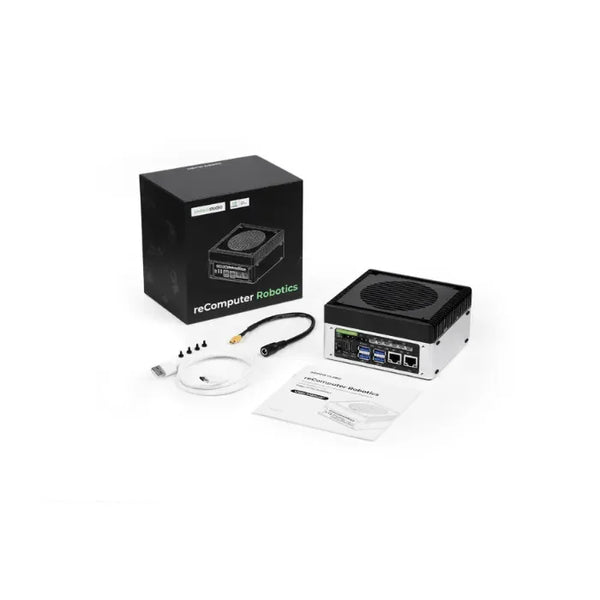
An included XT30 to 5.5mm DC Jack cable facilitates connection to standard power adapters, simplifying initial setup and testing. The wide input voltage range allows the reComputer Robotics J4012 to operate from 24V industrial power supplies commonly found in factory environments, as well as 48V battery systems used in autonomous mobile robots and electric vehicles.
The device supports four power modes: 10W, 15W, 25W, and 40W, allowing developers to balance performance against power consumption and thermal output based on their specific application requirements. This flexibility is particularly valuable for battery-powered robots where power budget is a critical design constraint.
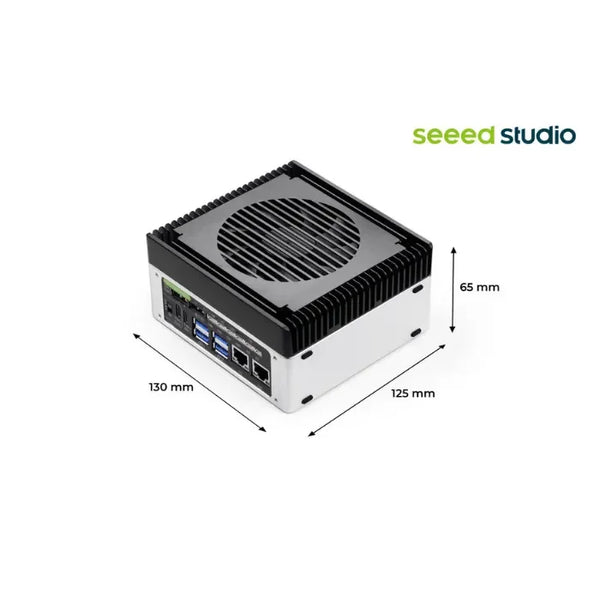
Physically, the reComputer Robotics J4012 measures 115mm x 115mm x 38mm and weighs approximately 200g, making it compact enough for integration into space-constrained robotic systems while still providing robust processing capabilities. The included aluminum case with integrated heatsink and fan ensures reliable thermal management even under sustained high-load operation.
Operating temperature ranges from -20°C to 60°C in 25W mode and -20°C to 55°C in MAXN mode (with the reComputer Robotics heatsink and fan installed), enabling deployment in challenging industrial environments including cold storage facilities and outdoor applications.
Software and Development Environment
One of the key advantages of the Seeed Studio reComputer Robotics J4012 is its comprehensive software support. The device comes pre-installed with NVIDIA JetPack 6.2 and a Linux Board Support Package (BSP), providing a complete software environment for AI development and deployment. This means developers can begin working on their applications immediately without spending time on system setup and configuration.
NVIDIA JetPack is the comprehensive software development kit for Jetson platform development, providing the tools, libraries, APIs, and sample code necessary to accelerate development across the entire AI application pipeline. It includes support for popular deep learning frameworks including TensorFlow, PyTorch, and MXNet, allowing developers to leverage their existing AI model development workflows.
For computer vision applications, JetPack includes CUDA-accelerated versions of OpenCV and other vision processing libraries. The inclusion of the NVIDIA Container Runtime enables deployment of AI models in Docker containers, simplifying application distribution and system updates in production deployments.
Seeed Studio also provides additional software resources and documentation specific to the reComputer Robotics series, including drivers for the GMSL extension board, camera integration guides, and example applications demonstrating common robotics use cases. This comprehensive documentation significantly reduces the learning curve for developers new to the Jetson platform.
Applications and Use Cases
The Seeed Studio reComputer Robotics J4012 is purpose-built for robotics applications, with its feature set optimized for the most common use cases in autonomous systems, industrial automation, and intelligent machines.
Humanoid Robots and Manipulation
The reComputer Robotics J4012 serves as an ideal computing brain for humanoid robots, where its powerful AI capabilities enable rich perception, precise motion control, and complex decision-making. The platform can process multiple camera inputs for environment awareness, run real-time neural networks for object detection and recognition, and coordinate with motor controllers through CAN bus interfaces - all simultaneously.
For manipulation tasks, the low-latency communication capabilities of the reComputer Robotics J4012 enable precise control of robotic arms and grippers. The combination of vision processing, AI inference, and deterministic control makes it possible to implement sophisticated manipulation strategies that can adapt to variations in objects and environments.
Autonomous Mobile Robots (AMRs) and AGVs
Autonomous mobile robots and automated guided vehicles represent one of the fastest-growing segments in robotics, with applications in warehousing, manufacturing, and logistics. The reComputer Robotics J4012 provides all the computing capabilities necessary for autonomous navigation, including LiDAR processing, simultaneous localization and mapping (SLAM), path planning, and obstacle avoidance. For developers exploring other NVIDIA Jetson options, consider the reComputer J4012 or reComputer J2021 for different configuration options.
The CAN bus interfaces enable direct connection to motor controllers for wheel or track drive systems, while the multiple UART ports support various LiDAR sensors commonly used in AMR navigation. The dual Gigabit Ethernet ports facilitate integration with warehouse management systems and enable high-bandwidth communication for fleet coordination and centralized monitoring.
In logistics robot applications, the USB ports can connect barcode scanners for parcel identification, while the extensive I/O options enable integration with conveyor systems, elevators, and other automated equipment. The rugged industrial design ensures reliable operation in the demanding environments typical of warehouses and distribution centers.
Industrial Vision and Quality Control
The powerful video processing capabilities of the reComputer Robotics J4012 make it well-suited for industrial vision applications including quality control, inspection, and process monitoring. The hardware-accelerated video encoding and decoding enable real-time processing of multiple high-resolution camera feeds for defect detection, measurement, and classification tasks. For edge AI computing applications, this platform provides the perfect balance of performance and efficiency.
The GMSL camera support is particularly valuable for industrial vision applications, as it enables the use of automotive-grade cameras designed for reliable operation in challenging environments. These cameras can be positioned throughout manufacturing facilities at distances up to 15 meters from the computing unit, providing comprehensive coverage without signal degradation.
Combined with the AI inference capabilities, the reComputer Robotics J4012 can implement sophisticated quality control systems that not only detect defects but also learn from production data to improve accuracy over time. The ability to run multiple neural networks simultaneously enables multi-task vision systems that can perform inspection, tracking, and classification in a single pass. If you're looking for other edge computing options, check out the NVIDIA Jetson Orin Nano or Jetson AGX Orin for different performance profiles.
3D Vision and Depth Sensing
The support for stereo vision cameras including the Orbbec Gemini 335LG enables advanced 3D perception capabilities essential for modern robotics applications. Autonomous mobile robots (AMRs) benefit greatly from depth sensing capabilities, enabling precise obstacle detection, bin picking, and environment mapping that would be impossible with traditional 2D cameras alone.
In collaborative robot applications, 3D vision enables safe human-robot interaction by providing accurate distance measurements between robots and human workers. For autonomous vehicles, depth perception is critical for reliable navigation in dynamic environments. The combination of 3D cameras with the powerful AI processing of the reComputer Robotics J4012 enables these advanced applications to be implemented with minimal additional hardware. Other Seeed Studio products like the reComputer Robotics J5012 with GMSL offer even more performance for demanding applications.
Comparison with Alternatives
When evaluating the Seeed Studio reComputer Robotics J4012, it's helpful to compare it with other options in the Jetson ecosystem and alternative platforms from other manufacturers. The combination of the powerful Jetson Orin NX processor with the robotics-focused carrier board makes the reComputer Robotics J4012 uniquely positioned for robotics applications. For those comparing across different brands, you might also explore Raspberry Pi AI Kit or Arduino Portenta Machine Control as alternative solutions.
Compared to the standard Jetson Orin NX development kit, the reComputer Robotics J4012 offers significantly more comprehensive I/O options specifically designed for robotics. The development kit provides basic connectivity, but the reComputer Robotics J4012 includes multiple CAN bus ports, industrial I/O headers, and the integrated GMSL extension that would require additional modules and custom development to replicate. Other industrial options like the LinkStar Industrial may also be worth considering for specific use cases.
Alternative platforms from other manufacturers may offer similar processing capabilities but typically lack the comprehensive software support and documentation provided by Seeed Studio. The pre-installed JetPack and Linux BSP, combined with Seeed's extensive documentation and community resources, significantly reduce development time and technical risk.
The industrial-grade design of the reComputer Robotics J4012, with its wide operating temperature range and robust construction, also distinguishes it from consumer-oriented development platforms that may not meet the reliability requirements of production robotics deployments.
Getting Started with the reComputer Robotics J4012
For developers interested in building robotics applications with the Seeed Studio reComputer Robotics J4012, the platform provides multiple resources to accelerate development. The included user manual and documentation cover hardware setup, software configuration, and basic application development patterns. If you're new to the Jetson ecosystem, you might also want to explore the Jetson Nano 8GB as a learning platform before scaling up to the J4012.
Seeed Studio maintains an active community forum and extensive documentation covering common robotics applications. Example projects demonstrating camera integration, CAN bus communication, motor control, and AI inference provide starting points for custom development. The use of standard software frameworks and APIs ensures that existing Jetson code can be ported to the reComputer Robotics J4012 with minimal modifications.
For hardware integration, the comprehensive I/O options and standard connectors simplify connection to common robotics components. The included carrier board schematics and mechanical drawings enable custom enclosure design and integration into existing robotic systems.
External Resources
NVIDIA Jetson - Wikipedia | Robotics - Wikipedia | Edge Computing - Wikipedia | Computer Vision - Wikipedia | NVIDIA JetPack SDK | Seeed Studio Jetson Examples - GitHub | NVIDIA Jetson Orin Official
Frequently Asked Questions
What is the AI performance of the Seeed Studio reComputer Robotics J4012?
The reComputer Robotics J4012 delivers up to 157 TOPS of AI computing power when operating in MAXN mode with the NVIDIA Jetson Orin NX 16GB module. This is approximately 1.7x the performance of previous generation Jetson platforms, enabling real-time inference of complex neural networks for robotics applications.
What cameras are compatible with the reComputer Robotics J4012?
The reComputer Robotics J4012 supports various GMSL cameras including models from Sensing (SG3S-ISX031C-GMSL2F, SG2-AR0233C-5200-G2A, SG2-IMX390C-5200-G2A, SG8S-AR0820C-5300-G2A) and Orbbec (Gemini 335LG). It can support up to 4 cameras directly, or up to 8 cameras using virtual channels.
Does the reComputer Robotics J4012 come with software pre-installed?
Yes, the reComputer Robotics J4012 comes pre-installed with NVIDIA JetPack 6.2 and Linux BSP, so you can start developing AI applications immediately without needing to flash the system software.
What power input does the reComputer Robotics J4012 require?
The reComputer Robotics J4012 accepts power input from 19V to 54V DC through an XT30 connector. An XT30 to 5.5mm DC Jack cable is included for use with standard power adapters. The device supports power modes of 10W, 15W, 25W, and 40W.
What industrial interfaces does the reComputer Robotics J4012 provide?
The reComputer Robotics J4012 includes 2 CAN0 ports (via XT30 connectors) and 3 CAN1 ports (via 4-pin headers), 2 I2C headers, 1 UART header, and support for RS-485 communication. These interfaces enable connection to industrial sensors, motor controllers, and other automation equipment.
What is GMSL and why is it important for robotics?
GMSL (Gigabit Multimedia Serial Link) is a high-speed serial communication protocol for transmitting video and data over long distances (up to 15 meters). In robotics, GMSL enables connection of multiple cameras to the computing unit using single coaxial cables that carry both data and power, simplifying cable management and enabling flexible camera placement.
Can the reComputer Robotics J4012 operate in extreme temperatures?
Yes, the reComputer Robotics J4012 operates from -20°C to 60°C in 25W power mode and -20°C to 55°C in MAXN mode (with the included heatsink and fan). This wide temperature range enables deployment in industrial environments and outdoor applications.
What is included in the box with the reComputer Robotics J4012?
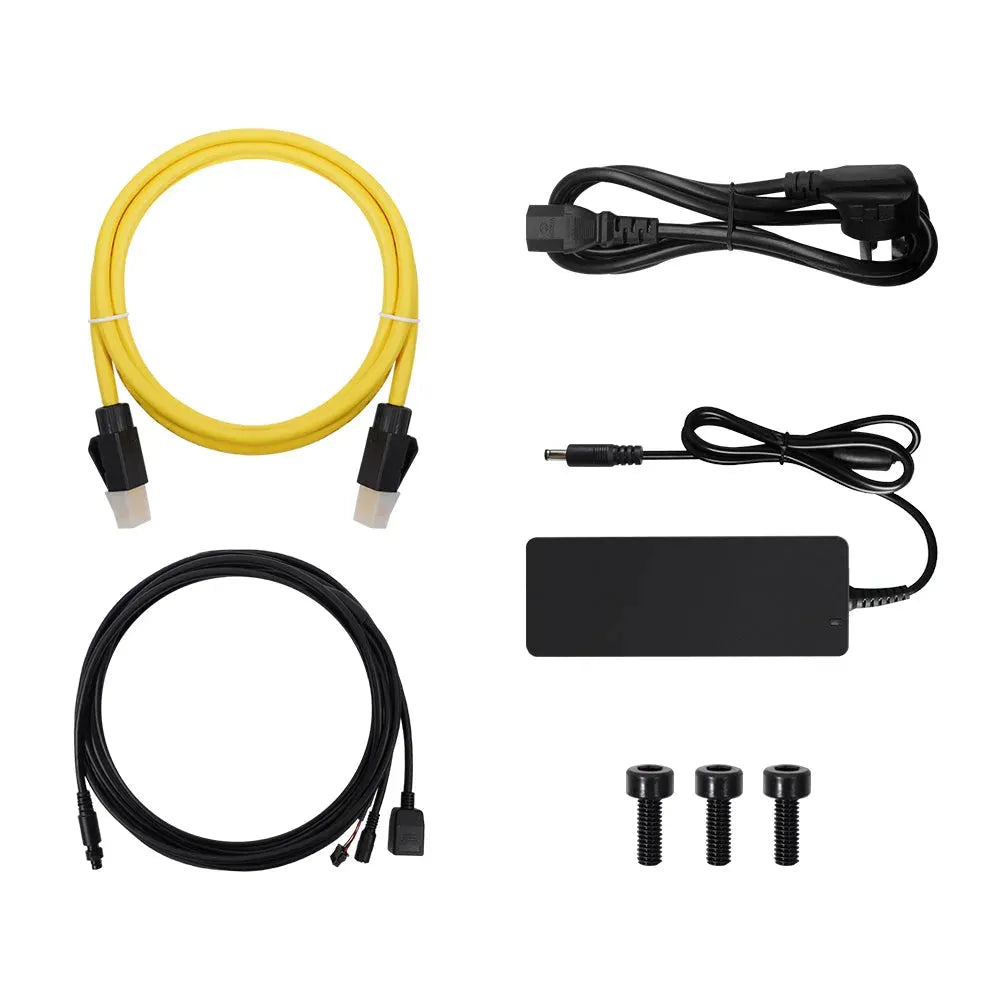
The package includes the Jetson Orin NX 16GB module, Seeed Carrier Board with GMSL Extension, 128GB NVMe SSD, aluminum case with heatsink and fan, USB Type-A to Type-C cable, XT30 to DC cable, and user manual.
Is the reComputer Robotics J4012 suitable for autonomous vehicles?
Yes, the reComputer Robotics J4012 is well-suited for autonomous vehicle applications thanks to its powerful AI processing, GMSL camera support for multiple high-resolution cameras, CAN bus interfaces for vehicle control systems, and industrial-grade design for reliable operation in challenging environments.
What certifications does the reComputer Robotics J4012 have?
The reComputer Robotics J4012 is certified for RoHS, CE, FCC, and KC (with KC certification pending). These certifications ensure compliance with international safety and electromagnetic compatibility standards for industrial equipment.
Conclusion
The Seeed Studio reComputer Robotics J4012 with GMSL Extension represents a compelling solution for developers and companies building next-generation robotics applications. Its combination of powerful NVIDIA Jetson Orin NX processing, comprehensive I/O options, integrated GMSL camera support, and industrial-grade design makes it uniquely well-suited for demanding robotics applications ranging from humanoid robots to autonomous mobile vehicles. The device is also listed on Seeed Studio's official website with additional resources and documentation.
The pre-installed software and comprehensive documentation significantly reduce development time, while the extensive connectivity options ensure compatibility with the diverse sensors, actuators, and communication systems used in modern robotics. For additional learning resources, check out Seeed Studio's blog for tutorials and project ideas. Whether you're prototyping a new robotic system or deploying production equipment, the reComputer Robotics J4012 provides a solid foundation for intelligent edge computing in robotics.
The platform's 2-year warranty and certifications (RoHS, CE, FCC, with KC pending) provide additional confidence for commercial deployments. These certifications ensure compliance with international standards for safety and electromagnetic compatibility, which is often required for industrial equipment deployment.
As AI continues to transform the robotics industry, platforms like the Seeed Studio reComputer Robotics J4012 make advanced capabilities accessible to developers without requiring custom hardware development. The combination of proven NVIDIA AI architecture with Seeed's expertise in embedded systems creates a platform ready for the challenges of modern robotics development.